
AC Not Cooling? 9 Common Causes and How to Fix Them
Sacramento summers are not gentle. When outdoor temps push past 100°F—sometimes reaching 110°F in the Central Valley—your air conditioner carries the whole household. So when the AC is running but the house stays warm, the problem feels urgent. The good news: most cases of an AC not cooling come down to one of nine fixable causes. Some you can handle in five minutes. Others need a licensed tech. This guide walks through all nine, so you know exactly what you are dealing with.
Key Takeaways
- A clogged air filter is the single most common cause of AC not cooling—check it first, every time.
- Refrigerant leaks require a licensed HVAC technician; DIY refrigerant handling is illegal without EPA Section 608 certification.
- Frozen evaporator coils are almost always a symptom of another problem—dirty filter, low refrigerant, or blocked airflow.
- Sacramento's extreme summer heat (regularly above 100°F) pushes AC systems harder than most of the country, making maintenance more critical here than in cooler climates.
- A system that runs constantly but never cools the house may simply be undersized for your square footage.
Quick Troubleshooting Table
Use this to narrow down the problem before reading the full sections below.
| Symptom | Likely Cause | DIY or Pro? |
|---|---|---|
| Air from vents is warm, filter looks gray | Dirty air filter | DIY — replace filter |
| System runs but house stays hot, ice on copper lines | Low refrigerant / leak | Pro only |
| Frost or ice on indoor coil | Frozen evaporator coil | DIY thaw + filter check; Pro if it recurs |
| Outdoor unit running but weak airflow inside | Dirty condenser coils | DIY rinse with garden hose; Pro for deep clean |
| AC will not turn on or start | Tripped breaker or bad capacitor | DIY for breaker; Pro for capacitor |
| Fan runs but compressor does not | Failed capacitor | Pro only |
| House stays warm, unit runs nonstop | Undersized unit or extreme outdoor heat | Pro assessment |
| Water pooling near indoor unit | Clogged condensate drain | DIY flush with diluted bleach |
| Cool air but thermostat shows odd readings | Thermostat issue | DIY settings check; Pro if wiring suspected |
1. Dirty Air Filter — The #1 Cause of AC Not Cooling
A clogged air filter is the single most common reason an AC stops cooling. It blocks the airflow your system needs to function, and without enough air passing over the evaporator coil, the coil cannot absorb heat from your home. In a Sacramento summer, a filter can go from clean to clogged in as little as 30 days.
Your AC pulls warm indoor air across a cold evaporator coil to cool it. The filter sits upstream, catching dust, pet dander, and debris. When the filter clogs, airflow drops below the threshold the manufacturer designed for. The evaporator coil gets too cold, sometimes freezing solid, and your vents blow weak, warm air.
How to tell: Hold the filter up to light. If light does not pass through it, replace it. A dirty filter looks gray or tan, not white.
DIY fix: Replace the filter. Standard 1-inch filters should be swapped every 30 days during peak cooling season. If you have pets or live near a dusty road, check every two to three weeks. After replacing, give the system 20–30 minutes to return to normal before assuming the problem is something else.
When to call a pro: If the coil froze, turn the system off, let it thaw completely (two to four hours with the fan on but cooling off), replace the filter, then restart. If it freezes again, a deeper problem—low refrigerant or a blocked return duct—is likely at work.
2. Low Refrigerant — Is Your AC Leaking?
Low refrigerant is the second most common cause of an AC not cooling. Unlike the oil in your car, refrigerant does not get consumed. If your system is low, it means there is a leak somewhere in the sealed refrigerant circuit. The EPA estimates residential systems lose around 5–11% of their refrigerant charge per year on average, according to RMI, 2024.
Refrigerant is what actually moves heat. The system uses it to absorb heat from your indoor air and dump that heat outside. When the charge drops, the system loses that capacity. Run it long enough on low refrigerant and you risk damaging the compressor—a repair that can cost thousands.
Research also shows that 78% of systems studied were found to be undercharged from the time of original installation, often because extra refrigerant was never added to account for longer pipe runs, per RMI, 2024. Even a 10% reduction in charge lowers efficiency, and losing more than 20% of charge causes steep performance drops.
How to tell: Warm air from vents, ice forming on the refrigerant lines or indoor coil, a hissing or bubbling sound near the unit, and rising indoor humidity are all signs of a possible refrigerant leak.
DIY check: Look at the copper refrigerant lines running into your indoor unit. Ice or frost on them during operation is a red flag.
Call a pro: Refrigerant handling requires EPA Section 608 certification. A technician will use a leak detector to find the source, repair it, then recharge the system to the manufacturer's specified level. Never add refrigerant without fixing the leak first—it will just leak out again.
3. Frozen Evaporator Coil
A frozen evaporator coil does not cool your home—it blocks heat transfer entirely. When the coil is encased in ice, the refrigerant cannot absorb heat from your air. The result is warm air from vents or no airflow at all. Frozen coils are almost always a symptom of another problem, not the root cause itself.
The two most common triggers are a dirty air filter (insufficient airflow) and low refrigerant (the coil drops below freezing because there is not enough refrigerant pressure to keep temperatures stable). Blocked return air vents—furniture pushed against them, closed dampers—can also cause this.
How to tell: Check the indoor unit. If you see frost or ice on the copper tubing or the coil itself, you have a frozen coil. The system may still run, but cooling output will be poor or zero.
DIY steps:
- Turn the system to "fan only" (not cooling) or turn it off entirely.
- Let it thaw—two to four hours minimum.
- Replace the air filter.
- Check that all return air vents are open and unobstructed.
- Restart and monitor.
Call a pro: If the coil refreezes within a day or two of doing all of the above, you likely have a refrigerant leak or a failing blower motor that needs professional diagnosis. See our AC repair services if you are in the Sacramento area.
4. Dirty Condenser Coils
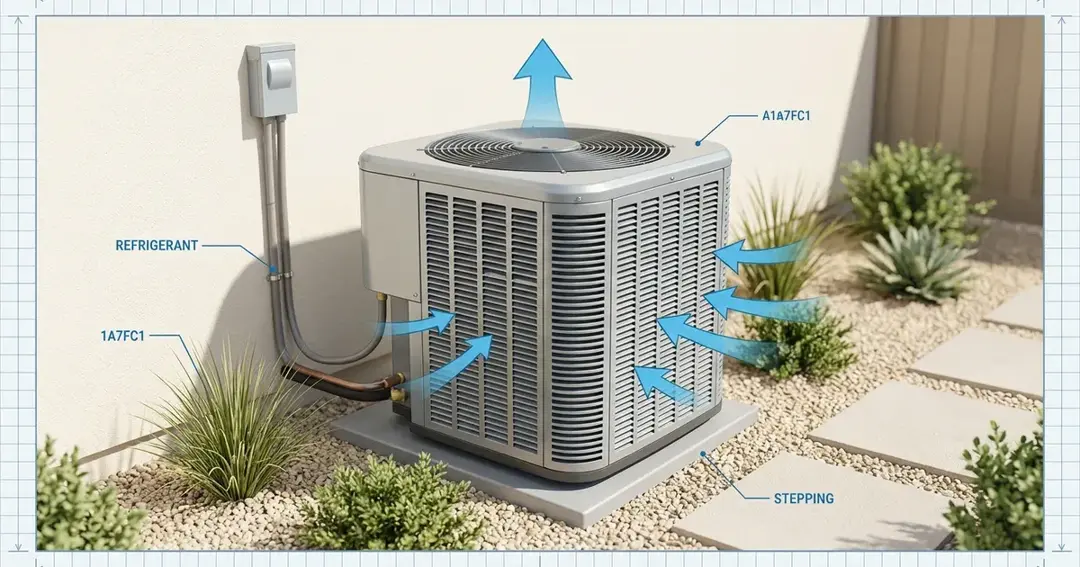
Dirty condenser coils are a major cause of an AC not cooling properly in Sacramento. The outdoor condenser unit dumps the heat your AC pulls from your home into the outside air. When the coil is caked with dust, grass clippings, or cottonwood seeds, it cannot release that heat—and your system's cooling capacity drops.
In Sacramento's summer heat, this matters more than in most cities. When it is 105°F outside, the temperature differential the system relies on is already thin. Add a dirty coil, and the outdoor unit can trip on high-pressure safety limits or cycle off repeatedly—leaving you with warm air inside.
How to tell: Look at the outdoor unit. Coil fins should be mostly visible and metal-colored. If they look gray, fuzzy, or packed with debris, they need cleaning. Also check for plants, shrubs, or structures within two feet of the unit—restricted airflow around the unit has the same effect.
DIY check: Turn off the unit at the breaker. Use a garden hose on a gentle setting to rinse the fins from the inside out (do not use a pressure washer—it bends the fins). Let it dry for 15 minutes before restarting.
Call a pro: For a thorough coil cleaning with approved coil-cleaning solution, and to inspect the fins for damage, schedule an annual AC maintenance visit. Bent fins can be combed straight by a technician to restore proper airflow.
5. Thermostat Problems
A misconfigured or failing thermostat can make a perfectly good AC system appear broken. This is the easiest possible fix—and the one most homeowners overlook. Before calling anyone, spend two minutes at the thermostat.
The most common thermostat mistake: the fan is set to "ON" instead of "AUTO." When the fan runs continuously, it pushes air through the vents even when the compressor is off and the system is not actively cooling. The air coming out feels warm because it is—the system is just circulating, not cooling.
How to tell:
- Set the thermostat to "COOL" and at least 5°F below current room temperature.
- Set the fan to "AUTO," not "ON."
- Check battery level if it is a battery-powered thermostat.
- If the display is blank or behaving erratically, replace the batteries.
DIY fix: Correct the settings and wait 15 minutes. If the system starts cooling, you are done. If the compressor does not kick on after that, the issue is elsewhere.
Call a pro: If the thermostat is more than 10–15 years old, runs continuously without accurate temperature readings, or the wiring terminals show corrosion, a technician can test and replace it. Smart thermostat installation is a straightforward job that often pays for itself in energy savings.
6. Failed Capacitor
A bad capacitor is one of the most common repairs during Sacramento heat waves. Capacitors are small electrical components that give the compressor and fan motors the boost they need to start and keep running. They fail more often in extreme heat—exactly the condition you need them most.
According to MRV Service Air, sustained high ambient temperatures cause capacitors to bulge, leak, or lose charge capacity, preventing motors from starting or burning them out. At 110°F outdoor temperatures, capacitors are under far more stress than they were designed for in standard operating conditions.
How to tell: The compressor hums but does not start, the outdoor fan spins slowly or not at all, or the system tries to kick on and then shuts off within seconds. Sometimes you will hear a clicking or humming sound from the outdoor unit without it fully engaging.
DIY check: Look at the outdoor unit when the system tries to start. If the fan blade is not spinning or is spinning very slowly, a bad run capacitor is the likely culprit.
Call a pro: Capacitors store a lethal electrical charge even when power is off. This is not a DIY repair. A technician can test the capacitor with a multimeter, replace it in under an hour, and check other electrical components while on site. Cost is typically modest compared to most AC repairs.
7. Tripped Breaker or Electrical Issue
An AC not cooling might simply have no power. A tripped circuit breaker cuts power to the system without any visible sign of trouble—the thermostat display can stay on while the outdoor unit sits completely dead. This is a quick check that takes under two minutes.
Breakers trip for several reasons: a momentary power surge, running too many high-draw appliances simultaneously, a compressor that briefly drew excess current on startup, or—more seriously—a wiring fault or failing component that is drawing too many amps. According to Trane, a blown fuse or open circuit breaker is a common first step to check when an AC will not run.
How to tell: Go to your electrical panel. Find the breaker labeled for the AC or air handler. If it is in the middle position (not fully on or fully off), it has tripped. Some units also have a disconnect box near the outdoor unit—check that too.
DIY fix: Switch the breaker fully off, wait 30 seconds, then switch it back on. Then wait five minutes before restarting the AC (the system needs time to equalize refrigerant pressures).
Call a pro: If the breaker trips again within a short time, do not keep resetting it. A repeatedly tripping breaker signals an underlying electrical problem—failing compressor, short in the wiring, or overloaded circuit—that a technician needs to diagnose safely.
8. Clogged Condensate Drain Line
A blocked condensate drain line will not always stop your AC from blowing cold air—but it can shut the whole system down if ignored. Most modern systems have a safety float switch that cuts the AC off when the drain pan fills up, preventing water damage to your home.
As your AC cools the air, it pulls moisture out of it. That condensation drips into a drain pan and flows out through a PVC drain line. Over a Sacramento summer, algae and mold can grow in that line and create a clog. When the pan overflows, the float switch trips and the system shuts off entirely.
How to tell: Water pooling near the indoor air handler, musty smells from the vents, or the system cutting off even though it was cooling fine are all signs of a drain issue. Look at the drain pan under the indoor unit—if it has standing water, the drain is blocked.
DIY fix: Mix one cup of white vinegar with one cup of water. Locate the condensate drain access port (a capped PVC pipe near the indoor unit) and pour the solution in slowly. Per Trane, a cup of boiling water down the drain pipe periodically—with the system off—also keeps algae from building up. Check monthly during summer.
Call a pro: If the line is fully blocked and the float switch has triggered, a technician can use a wet-vac to clear the clog and flush the line. Recurring clogs sometimes indicate the drain was installed without enough slope—a fix that requires repositioning the line.
9. Undersized AC Unit
An undersized AC unit is not broken—it is simply too small to keep up with your home's cooling load. The system runs constantly, never shuts off, and the house stays warm anyway. This becomes most obvious on Sacramento's hottest days, when 110°F outdoor temperatures push any system to its limits.
Per MRV Service Air, most residential units are designed to maintain a 20°F temperature difference between outdoors and indoors. At 110°F outside, keeping a house at 75°F asks the system to work at or past its design limit. An undersized unit has no margin—it just falls behind.
Homes also change over time. A garage conversion, a sunroom addition, or removal of old shade trees can increase the cooling load the system was originally sized for. The Department of Energy notes that improper sizing is a common installation mistake that affects long-term efficiency and comfort.
How to tell: The system runs continuously without shutting off, every room is roughly the same temperature (warm), and the problem gets significantly worse as outdoor temps climb above 95°F. An oversized unit—which is also a problem—will short cycle, running for only a few minutes at a time.
DIY check: Look at the unit's tonnage (usually on the data plate on the outdoor unit). A rough rule of thumb is 1 ton of cooling capacity per 500–600 square feet in a well-insulated California home, but the actual calculation depends on ceiling height, insulation, window size, and sun exposure.
Call a pro: A proper Manual J load calculation by a licensed HVAC contractor is the only reliable way to know if your system is sized correctly. If the unit is genuinely undersized, replacement is the long-term fix. Short-term: close blinds on west-facing windows during afternoon hours, run ceiling fans to improve perceived comfort, and keep interior doors open for better circulation.
A Note on Sacramento's Heat
The 9 causes above apply everywhere, but Sacramento makes all of them more urgent. When temperatures exceed 95°F—which happens regularly from June through September—the outdoor unit's ability to dump heat degrades. The U.S. Department of Energy specifically notes that on very hot days a tripped high-pressure limit switch may stop the compressor. Dirty coils, a weak capacitor, or low refrigerant that might cause only mild discomfort in a mild climate can cause a full breakdown here.
Annual maintenance—cleaning coils, checking refrigerant charge, testing the capacitor, and replacing the filter—is the most reliable way to avoid a repair call during a heat wave when every HVAC company in town is booked solid.
If you have worked through this list and your AC is still not cooling, or if you found ice on your lines, heard unusual noises, or suspect a refrigerant leak, the next step is a professional diagnosis. A-CLASS Heating and Air serves Sacramento-area homeowners with honest, no-pressure AC repair and AC maintenance services. Family-owned since 2016. Call us at (916) 342-9108.
Frequently Asked Questions
Why is my AC running but not cooling the house?
The most common reasons are a clogged air filter blocking airflow, low refrigerant from a leak, or dirty condenser coils that cannot release heat. Check your filter first—replace it if it looks gray or blocked. If that does not fix it, call a licensed HVAC technician to diagnose the system.
Why is my house still hot even though the AC is on?
Your AC may be undersized for your home, have a refrigerant leak, or be struggling with dirty coils. In Sacramento, outdoor temps above 95°F push any system hard. If the unit runs constantly without cooling, the problem is likely mechanical—low refrigerant, failed capacitor, or dirty condenser coils—and needs a pro.
Can a dirty filter stop my AC from cooling?
Yes. A clogged filter starves the evaporator coil of airflow. Without enough air passing over it, the coil cannot absorb heat from your home. In severe cases, the coil freezes solid, and the system stops cooling altogether. Replacing a dirty filter is the single fastest DIY fix for a warm house.
Should I add refrigerant to my AC myself?
No. Refrigerant does not get used up—if your system is low, it means there is a leak. Adding refrigerant without fixing the leak is a temporary patch. Handling refrigerant also requires EPA Section 608 certification. Call a licensed technician to find the leak, fix it, then recharge the system properly.
How do I know if my AC has a refrigerant leak?
Signs include warm air from vents despite the system running, ice forming on the copper refrigerant lines or indoor coil, a hissing or bubbling sound near the unit, and rising indoor humidity. Do not attempt to diagnose or recharge refrigerant yourself—this requires a licensed HVAC technician with proper tools.
How often should I change my AC air filter in Sacramento?
Every 30 days during Sacramento summers. High dust levels, wildfire smoke, and continuous AC runtime during heat waves can clog a standard filter in weeks. Check it monthly, and replace it whenever it looks gray or light no longer passes through it easily.