
AC Compressor Repair: Cost, Signs & When to Replace
Your AC is running. The house is 85 degrees. You walk outside and the condenser fan is spinning, but nothing sounds right — a grinding noise, a hum that won't turn into a start, or dead silence from a unit that should be working hard. Nine times out of ten, that's a compressor problem.
AC compressor repair is one of the most consequential HVAC decisions a homeowner faces. The repair itself isn't cheap, and the wrong choice — fixing a compressor that should be replaced, or replacing a unit that could have been repaired — costs real money. This guide lays out exactly what the compressor does, what failure looks like before it gets catastrophic, what repairs and replacements actually cost in 2026, and how to make the call between fixing what you have and starting fresh.
We're A-CLASS Heating and Air, a family-owned Sacramento HVAC contractor since 2016. We've diagnosed and replaced hundreds of compressors in the Central Valley. These numbers and recommendations reflect what we see on the job.
Key Takeaways
What Does an AC Compressor Actually Do?
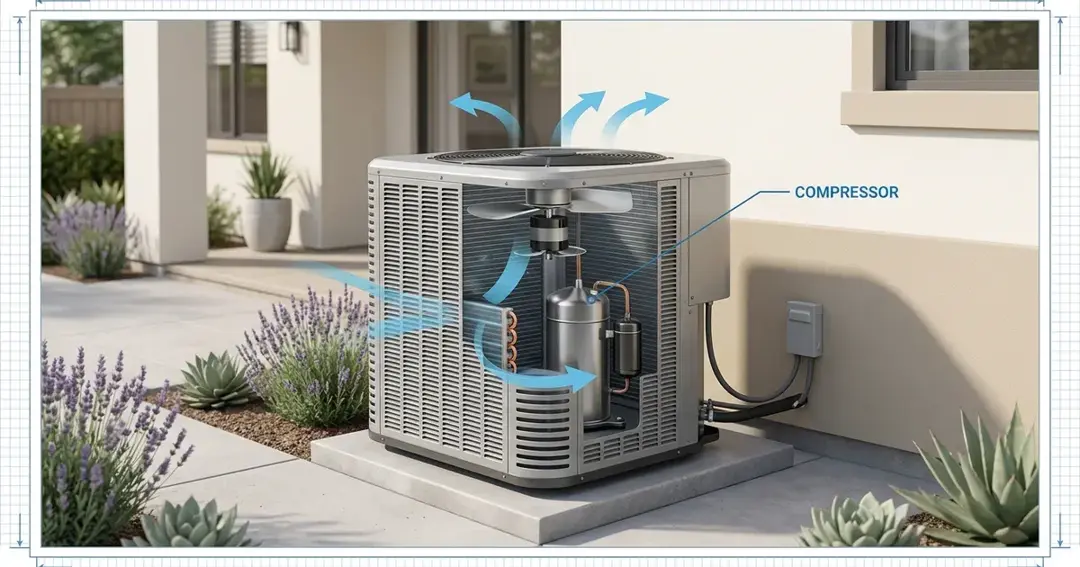
The compressor is the engine of your air conditioning system, and it does exactly what its name says: it compresses refrigerant gas, raising its temperature and pressure so the refrigerant can carry heat out of your home. Without a working compressor, refrigerant doesn't circulate, and your AC becomes an expensive fan.
The compressor lives inside your outdoor condenser unit — that metal cabinet in your backyard or on the side of your house. It runs every time your AC calls for cooling. On a Sacramento summer day when the outdoor temperature hits 105°F or higher, your compressor may run for 8 to 12 hours straight. That's a lot of stress on a sealed mechanical system.
Two things matter most for compressor health: refrigerant charge and airflow. Low refrigerant forces the compressor to work harder and can cause it to overheat. Restricted airflow from dirty condenser coils or a debris-blocked outdoor unit has the same effect. Either condition, left uncorrected, accelerates wear. According to ASHRAE, heavy use — 16 to 20 hours per day — cuts compressor lifespan by 10 to 15%.
A well-maintained residential compressor lasts 10 to 15 years. In harsh climates, that drops to 8 to 12 years (Consumer Reports, cited by Aristotle Air, 2025). Sacramento's combination of extreme heat, long cooling seasons, and spring cottonwood clogging outdoor coils puts local compressors firmly in the shorter end of that range.
What Are the Warning Signs of a Failing AC Compressor?
In 2026, the most common home AC complaint during Sacramento summers is warm air blowing from vents while the system appears to be running — a direct signal that the compressor is no longer circulating refrigerant effectively. Catching the earlier signs can save you from a full emergency breakdown at the worst possible moment.
Here are the six symptoms worth knowing:
1. Warm Air from the Vents
Your system runs. The air handler blows. But the air coming through your registers is room temperature or warm. This is the most obvious sign something is wrong with the refrigerant circuit — and the compressor is the most common culprit when refrigerant levels check out but cooling still fails.
2. Hard Starting
Hard starting means the outdoor unit struggles to kick on. You hear it try — a loud hum or clunk — then stop. Then it tries again. This cycling pattern puts serious stress on the compressor motor each time it attempts to start. Repeated hard starts lead to premature compressor failure.
The important diagnostic note here: hard starting is often caused by a failed run capacitor, not the compressor itself. A capacitor replacement runs $150 to $350. Always have a technician test the capacitor before assuming the compressor is gone.
3. Loud Noises from the Outdoor Unit
A healthy compressor runs with a steady hum. Banging, clanking, grinding, or rattling from the outdoor unit — especially sounds that appear suddenly — mean something has broken loose inside the compressor or a component has seized. These sounds don't improve on their own.
4. Circuit Breaker Tripping Repeatedly
A failing compressor can draw excessive current as it struggles to run, which trips the circuit breaker. If your AC breaker trips once after an unusual power event, it might be coincidence. If it trips every time you try to run the AC, that's a compressor (or capacitor/contactor) problem that needs immediate attention.
What we've seen in Sacramento: The first 100°F+ day of summer is the most common time we get called for a "dead compressor." In many cases, it turns out to be a capacitor that failed over the winter. The compressor itself is fine. A quick $250 repair gets the system running. Always ask your technician to test the capacitor first.
5. Refrigerant Leaks
Oily spots or staining around the outdoor unit, a hissing or bubbling sound when the system runs, or ice forming on the copper lines leading into your house all point to a refrigerant leak. Leaks can originate from the compressor itself or from the refrigerant lines. Either way, a system running low on refrigerant will eventually destroy the compressor if left alone.
6. Steadily Rising Energy Bills
A compressor that's losing efficiency runs longer to maintain the same cooling, which shows up on your electric bill. If your SMUD bill has crept up 15–20% compared to the same month last year and your usage habits haven't changed, the compressor is worth testing.
How Much Does AC Compressor Repair Cost?
AC compressor replacement for a central AC system costs $800 to $2,300 nationwide, with $1,200 as the most commonly cited average (This Old House, 2026; HomeAdvisor, 2025). Your actual cost depends on three main factors: system size, warranty status, and compressor type.
Cost by System Size
| Unit Size (Tons) | Compressor Cost (Parts + Labor) |
|---|---|
| 1.5–2 ton | $700–$1,400 |
| 2.5–3 ton | $900–$2,100 |
| 3.5–4 ton | $1,100–$2,200 |
| 4.5–5 ton | $1,300–$2,600 |
Source: HomeAdvisor, 2025; This Old House, 2026
Most Sacramento homes run 3 to 4-ton systems to handle square footage in the 1,500–2,500 sq ft range. That puts the typical job in the $1,000–$2,100 range for parts and labor.
How Warranty Status Changes Everything
This is the biggest cost variable. If your compressor is still under the manufacturer's warranty — most residential warranties run 10 years on the compressor — you'll pay only labor. That's typically $600 to $1,200 total. If the warranty has expired, you're buying the part too, which pushes the job to $1,300–$2,500 (HomeAdvisor, 2025).
One important caveat on warranties: most manufacturers require documented professional installation and regular annual maintenance to keep the warranty valid. Skipping tune-ups can void coverage.
Labor Costs
HVAC technicians bill $75 to $150 per hour for compressor work. A central AC compressor job typically takes four to six hours, so labor alone runs $300 to $900 (HomeAdvisor, 2025). Refrigerant recharge adds another $100 to $350, or up to $600 if your older system runs on R-22 (which is no longer produced and expensive to source).
What About Minor Repairs?
Not every compressor problem requires a full replacement. Electrical issues — a failed capacitor, a bad contactor, or a wiring fault — can often be fixed for $150 to $400. These components protect the compressor and fail more often than the compressor itself. A good technician tests these first before recommending a compressor swap.
Refrigerant leak repairs run $200 to $1,500 depending on where the leak is and how much refrigerant needs to be recovered and recharged.
Repair vs. Replace: How to Make the Call
The most common mistake Sacramento homeowners make is deciding on repair vs. replace based only on the repair quote. The right framework uses three variables together: system age, warranty status, and refrigerant type. Here's how to think through each.
Use the Age-and-Warranty Rule
If your AC is under 10 years old and under warranty, replacing just the compressor is almost always the right move. You get a new compressor, and the rest of the system still has years of life left.
If your AC is 10 to 15 years old and out of warranty, the math shifts. A compressor replacement on a 12-year-old system might cost $1,500. A full system replacement runs $3,300 to $7,800 (HVAC.com, 2025). But the 12-year-old system has maybe 3 to 5 years left before other components start failing. Spending $1,500 now to get 3 more years out of a system you'll need to replace anyway is often the worse deal.
A useful shortcut: apply the $5,000 rule — multiply your system's age by the repair quote. If the result exceeds $5,000, lean toward replacement. A 12-year-old system with a $1,500 compressor repair hits $18,000 on that calculation, well over the threshold.
The Refrigerant Question
Systems manufactured before 2010 likely use R-22 refrigerant (Freon), which was phased out of production under EPA regulations. R-22 now costs significantly more than the current standard refrigerants, and supply is limited. Any time a compressor fails in a system that runs R-22, replacing the entire AC is almost always the smarter financial decision. You're not just buying a new compressor — you're buying continued dependence on an expensive, scarce refrigerant for a system that's already at least 15 years old.
Systems built after 2010 typically run R-410A. Systems sold after January 2025 use R-454B (Puron Advance) or R-32, which are more environmentally compliant. These refrigerants are readily available.
When a Failed Compressor Means Replacing the Whole Unit
There's a practical reason contractors often recommend replacing the outdoor condenser unit (not just the compressor) when a compressor fails: debris. When a compressor fails mechanically, metal particles and contaminants can circulate through the refrigerant circuit, reaching the condenser coil and the refrigerant lines. Putting a new compressor into a contaminated system can shorten the new compressor's life significantly.
Replacing the entire outdoor condenser unit addresses this by replacing the compressor, condenser coil, and fan motor together. It costs more upfront than a compressor swap — typically $2,500 to $4,500 — but you get a cleaner system with a new warranty on all the major components.
For a deeper look at the full repair-or-replace decision, our guide to AC system repair options walks through the diagnostic process we use on every service call.
How Sacramento's Heat Changes the Equation
Sacramento's climate is genuinely hard on compressors. Afternoon temperatures regularly hit 105°F to 115°F during heat waves, and the outdoor unit sits in that heat while rejecting thermal energy from your home. According to local HVAC contractors, the discharge temperatures inside a compressor during peak Sacramento summer operation can exceed 200°F.
That sustained heat load does two things:
- It reduces compressor lifespan. Heavy use — 16+ hours of operation per day during a Sacramento heat wave — cuts compressor life by 10 to 15% according to ASHRAE estimates, cited by Aristotle Air (2025). A compressor rated for 15 years in a mild climate might realistically last 11 to 12 years here.
- It accelerates the failure cascade. Sacramento also deals with cottonwood season in spring. Cottonwood fibers pack into outdoor condenser coils, blocking airflow. When summer heat arrives and the coils are already restricted, head pressure inside the compressor spikes. That pressure spike is one of the leading causes of compressor overheating and burnout.
What we see every June: The first heat wave of the year is when we get the most emergency calls. Systems that sat idle all winter restart without warning. If a capacitor weakened last fall, it may not fail until the compressor tries to start in 102°F heat. A spring tune-up — where we test capacitors, clean coils, and check refrigerant charge — catches most of these issues before they become emergencies.
The U.S. Department of Energy estimates that neglected systems lose about 5% efficiency per year. Over a decade, that adds up to a system running 50% less efficiently than it did when new — and working that much harder to cool your home during a Sacramento summer.
How to Avoid a Premature Compressor Failure
Most compressor failures don't come out of nowhere. They build over years of small stresses: a capacitor working at 60% capacity, coils that haven't been cleaned in three seasons, a refrigerant charge that's drifted 5% low from a slow leak. None of those issues is catastrophic alone, but together they shorten compressor life significantly.
According to ACHR News, 30% of compressor failures are caused by installation errors — improper refrigerant charge, incorrect line sizing, or electrical mismatches. That's a reminder that the quality of your original installation matters as much as ongoing maintenance.
Here's what actually extends compressor life:
- Annual tune-up: A technician checks refrigerant charge, tests capacitors and contactors, cleans coils, and inspects electrical connections. Cost: $100–$250. Benefit: adds 2 to 5 years of compressor life, according to Aristotle Air (2025).
- Filter changes every 1–3 months: A clogged filter reduces airflow across the evaporator coil, which affects refrigerant pressure and forces the compressor to work harder. The U.S. Department of Energy notes that dirty filters increase energy strain by 15%.
- Keep the outdoor unit clear: Trim shrubs to maintain at least 18 inches of clearance around the condenser. Rinse coils with a garden hose in spring to clear cottonwood and debris.
- Hard-start kit: If your system is 7+ years old and occasionally struggles to start, a hard-start kit ($50–$150 installed) provides an extra boost to get the compressor running with less motor strain.
If your current system needs AC work beyond basic maintenance, our AC system repair and AC installation pages cover what the diagnostic and replacement process looks like.
What to Expect from the Repair Process
The AC compressor repair process has a few steps worth understanding before a technician arrives.
Step 1: Diagnosis. A technician attaches gauges to test refrigerant pressure and checks electrical components — capacitor, contactor, and motor windings. This takes 30 to 60 minutes. If the compressor is seized or motor windings are shorted, replacement is the only option.
Step 2: Refrigerant recovery. Before removing the old compressor, the technician must recover all refrigerant into an EPA-certified recovery tank. Releasing refrigerant into the atmosphere is illegal under EPA Section 608.
Step 3: Compressor swap. The old unit is removed, refrigerant lines are flushed if contamination is suspected, and the new compressor is installed. Depending on compressor type and unit accessibility, this takes two to five hours.
Step 4: Recharge and test. The system is recharged with refrigerant to the manufacturer's specified charge (measured in subcooling and superheat, not just pressure). A proper charge test takes 15 to 30 minutes and is non-negotiable for system longevity.
One thing to watch for: be cautious of any contractor who quotes a compressor replacement without mentioning refrigerant recovery, a leak search, or an electrical component check. A compressor doesn't fail in a vacuum — something usually caused it. Replacing the part without addressing the root cause means the new compressor faces the same stress.
Frequently Asked Questions
How much does it cost to replace an AC compressor?
Replacing a central AC compressor costs $800 to $2,300, with a national average around $1,200 (This Old House, 2026). Systems under warranty pay mainly labor ($600–$1,200 total). Out-of-warranty replacements run $1,300–$2,500 once parts are included. Add $100–$350 for refrigerant recharge.
Is it worth replacing an AC compressor?
Worth it when: your system is under 10 years old and still under warranty. Not worth it when: the system is 10+ years old, out of warranty, and the repair quote is more than 50% of a new unit's cost. In Sacramento, also factor in whether your system runs R-22 — if it does, replacing the whole unit is almost always the better call.
What are the signs of a bad AC compressor?
The clearest signs are warm air blowing from vents when the system runs, loud banging or grinding from the outdoor unit, a circuit breaker that trips repeatedly when you try to run the AC, and the outdoor unit struggling to start. Oily residue near the outdoor unit can indicate refrigerant leaks from the compressor.
Can a failed compressor be repaired rather than replaced?
Electrical issues upstream of the compressor — capacitors, contactors, and wiring faults — can be repaired for $150 to $400 and often solve the problem. The compressor itself, once mechanically failed, typically can't be rebuilt cost-effectively for a residential system. The standard fix is a full compressor replacement.
How long does an AC compressor last in Sacramento?
Nationally, residential compressors last 10 to 15 years (Consumer Reports, via Aristotle Air, 2025). In Sacramento's climate — extreme summer heat, long cooling seasons, cottonwood-clogged coils — expect the lower end of that range: 10 to 12 years without regular maintenance, up to 15 years with it.
If you're hearing something wrong from your outdoor unit or your AC isn't keeping up with Sacramento heat, call A-CLASS Heating and Air at (916) 342-9108. We'll diagnose the problem honestly — test the capacitor before assuming it's the compressor, check refrigerant and electrical components, and give you a straight answer on whether repair or replacement makes more financial sense for your situation. No high-pressure sales, just what we'd tell a neighbor.
Frequently Asked Questions
How much does it cost to replace an AC compressor?
AC compressor replacement typically costs $800 to $2,300 for a central AC system, with $1,200 as the most commonly cited national average. If your compressor is still under warranty, expect to pay $600 to $1,200 — mainly for labor. Out-of-warranty jobs run $1,300 to $2,500.
Is it worth replacing an AC compressor?
It depends on your system's age and warranty status. If your AC is under 10 years old and the compressor is under warranty, replacement usually makes sense. If the system is 10 or more years old and out of warranty, replacing the entire outdoor unit or full system is often the smarter financial move.
What are the signs of a bad AC compressor?
The clearest signs are warm air coming from vents despite the system running, the outdoor unit making banging or grinding noises, the circuit breaker tripping repeatedly, and the AC struggling to start. Refrigerant leaks showing as oily spots near the outdoor unit are another strong indicator.
Can you repair an AC compressor instead of replacing it?
Minor electrical issues like a failed capacitor can be repaired at relatively low cost. However, mechanical failures inside the compressor itself are rarely repairable — the standard fix is a full compressor swap. Labor for the repair portion runs $75 to $150 per hour, or a flat $300 to $900 for the job.
Why does a failed AC compressor often mean replacing the whole unit?
When a compressor fails, debris and metal particles can circulate through the entire refrigerant circuit, contaminating the condenser coil and other components. On older systems using discontinued R-22 refrigerant, full system replacement is almost always the better financial choice over repairing a single part.
How long does an AC compressor last?
A residential AC compressor lasts 10 to 15 years under normal conditions, dropping to 8 to 12 years in harsh climates according to Consumer Reports. Sacramento's extreme summers — temperatures regularly above 105°F — put compressors at the shorter end of that range without regular maintenance.